Accounting for Z-Coordinates in MineTwin
The geometric length of a segment in MineTwin is calculated using its projection onto the horizontal plane (ignoring the Z-coordinate). At first glance, it may seem important to include Z-coordinates in length calculations, but the inaccuracy introduced by omitting them is minimal. The chart below demonstrates that even at a 15° inclination, the relative change in length does not exceed 3.5% compared to the XY-projection.
An error of 5% appears only at a 20° inclination, which is rarely encountered in real projects.
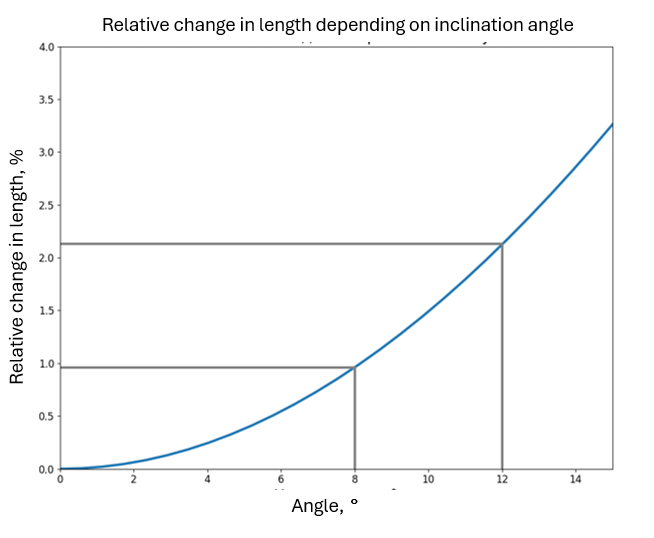
For example, a 100 m stope projected horizontally and inclined at 12° will have an actual length of 102.28 m, while in MineTwin its length will remain 100 m.
This leads to a natural question: how is the volume of extracted ore calculated, since it is directly proportional to the length of the mined section?
MineTwin provides functionality for incorporating expected volumes for this purpose. It is much more convenient to use values from the official project documentation rather than introduce multiple correction coefficients into MineTwin computations.
Using expected volumes is also justified by the specifics of how headings, corners, turns, and intersections are actually mined at a given site. The complex geological structure of the ore body and natural fracturing make it impossible to achieve a perfectly regular excavation profile.
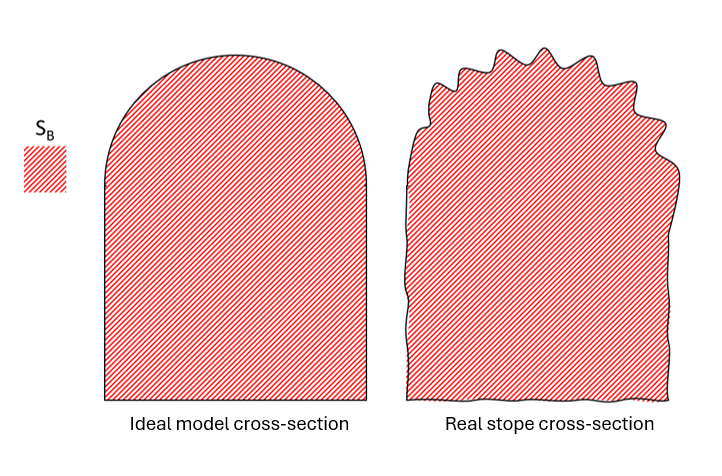
Actual extraction volumes always deviate from the design values, and this deviation can be significantly greater than the 1–3% geometric approximation error discussed above. By omitting Z-coordinate adjustments, MineTwin improves performance and usability while avoiding unnecessary calculations.