Ore, materials and ore quality
In MineTwin, ore types and materials are used for different purposes. The ore type defines the routing rules for the mined mass along the haulage chain, while materials are used to calculate the composition and quality of the ore. These parameters are set independently and are not automatically cross-validated. In practice, the ore type is always associated with the materials it contains. For example, nickel ore is expected to contain nickel, and so on. In MineTwin, however, the "ore type" and "material" parameters are not directly linked. A user could, for instance, specify the ore type for a stope as "nickel" while defining the material composition as 100% waste rock. For MineTwin, this is not considered an error. The mined mass from that stope will be routed to ore stockpiles, but the quality of that ore will be zero.
Ore types
In MineTwin, all minerals and waste rock extracted during mining operations are collectively referred to as ore. Ore is divided into types. The user can create any number of ore types in a scenario — for example, potash, nickel, blended, rocky, etc. Each type must be assigned a category: production or development.
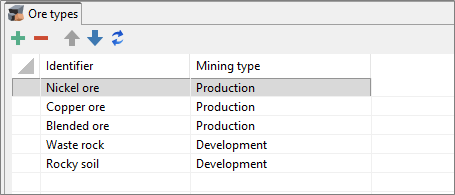
Ore types are used to determine routing to various destinations.
In MineTwin, the primary initial source of ore is stopes (Underground)/ blocks (OpenPit). Additionally, at the start of a simulation, some initial stock of ore may be present in ore passes and cross-dock points (Underground)/ dump areas (OpenPit).
It is assumed that each stope/ block contains rock mass of only one type. The rock mass is then transported to ore passes/ dump areas or cross-dock points (CDPs), for which a list of permitted ore types can be specified. Thus, ore of the "nickel" type will be transported only to specific ore passes, not to just any.
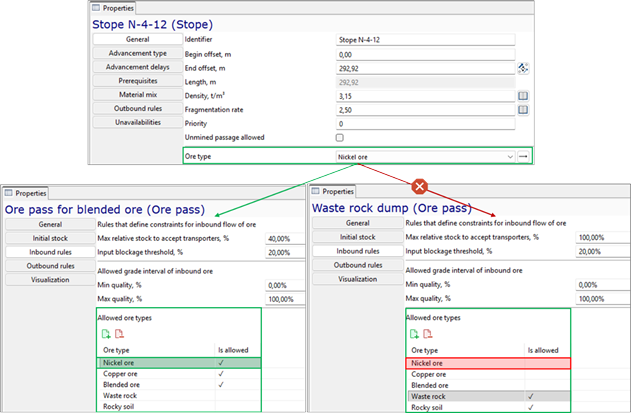
When transporting rock mass from CDPs and ore passes/ dump areas, the ore types permitted for acceptance are also taken into account.
Materials and ore quality
The rock mass contained in stopes/ blocks, ore passes/ dump areas, and other mine facilities consists of materials (including chemical elements). Depending on the chemical composition of the ore being mined, the user can create any number of materials in a scenario — for example, Ni, Cu, Fe, etc. Each material belongs to one of two types: valuable substance or empty rock.
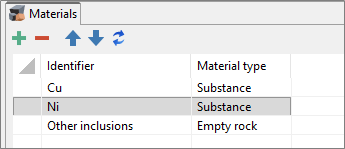
Materials are used to track ore quality in all storage locations at any point in time.
For all stopes/ blocks, as well as for any ore passes/ dump areas and CDPs that contain an initial stock of rock mass at the start of the simulation, the material composition of the rock mass must be specified.
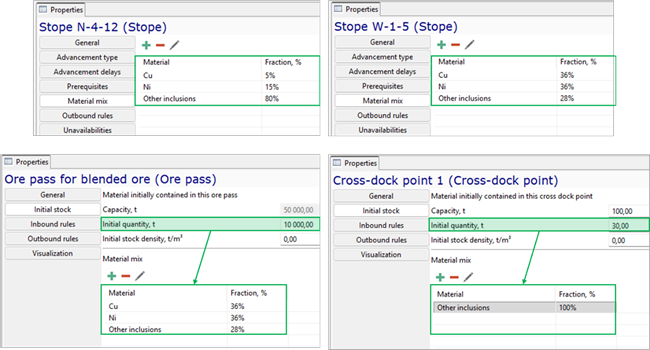
The sum of the content of all materials classified as "substance" gives the ore quality indicator. In the example below, the stope quality of 72% is made up of 36% copper content and 36% nickel content.
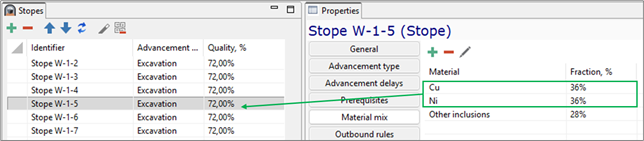
During the simulation, the quantity and quality of rock mass entering each object is tracked, and the average ore quality changes dynamically. Because ore quality is monitored at every stage of the material flow chain (conveyors, crushers, storages, skip hoists), the ore quality in any object is known at any point in the simulation.